
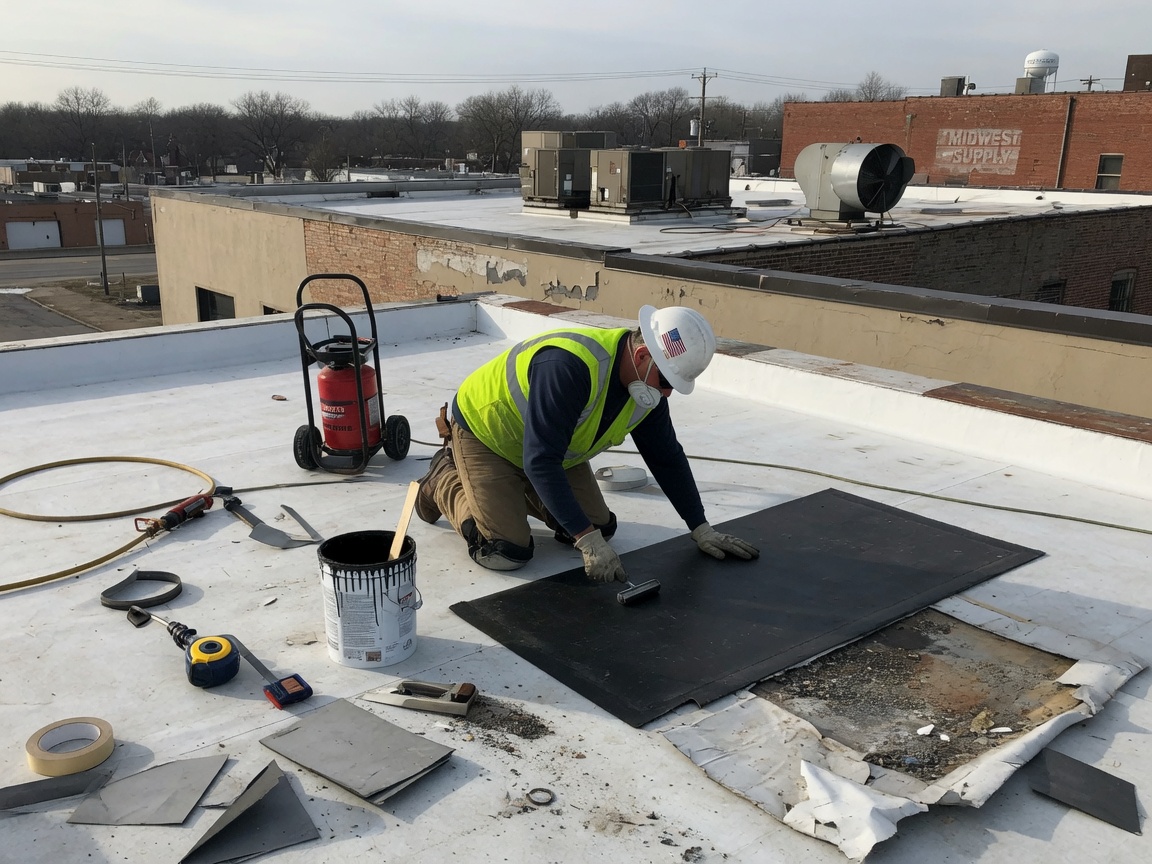
Rockford's humid continental climate brings heavy snow loads and repeated freeze-thaw cycles that stress commercial flat roof membranes. In neighborhoods such as Midtown and the Rockton Avenue Corridor, older commercial buildings often have TPO or EPDM systems installed over steel decks that expand and contract sharply when temperatures swing from single digits to above freezing. Technicians check for tenting at seams, punctures from ice movement, and clogged internal drains that back up meltwater against parapets. Proper repair requires matching the existing membrane manufacturer specifications so the patch remains compatible during the next winter cycle.
East Rockford and West Rockford commercial properties near the Rock River face additional wind-driven rain exposure that can force water under flashings at HVAC curbs and skylight bases. When performing repairs, crews remove loose gravel ballast only in the work zone to avoid disturbing the rest of the roof, then install new reinforced membrane sections with compatible adhesives rated for the local temperature range. Edge details along parapets are often the first failure points after several winters, so flashing height and termination bars are inspected against current wind-uplift expectations for Winnebago County.
Buildings in Downtown Rockford and the Coronado Performing Arts Center vicinity frequently have modified bitumen roofs with gravel surfacing that masks small blisters until they split. Repair crews use infrared scanning to locate wet insulation without unnecessary demolition, then cut out and replace only the affected sections before welding new cap sheet. This targeted approach prevents widespread disruption to tenants below while restoring drainage slopes that were altered by previous patchwork.
Technician insight
In Rockford, the thing that catches most people out with Commercial Flat Roof Repair is how quickly snowmelt refreezes inside poorly sloped drains on buildings in Midtown and along the Rockton Avenue Corridor, turning a small seam split into widespread deck rot by spring.
Midtown commercial building leak after heavy snow
Water was entering near two HVAC curbs on a 1980s modified-bitumen roof. Inspection showed the original flashing had pulled away after repeated freeze-thaw cycles. Crew removed wet insulation in a four-by-six-foot section, installed new tapered insulation to restore slope, and welded a reinforced TPO patch over the entire curb area. Drainage was restored and no further leaks occurred through the next winter.
Commercial Flat Roof Repair Services We Offer
✓TPO Membrane Repair
Heat-welded patches and seam restoration on commercial TPO systems to stop leaks before they reach the deck in Rockford buildings.
✓EPDM Patch Work
Splice-tape and adhesive repairs for EPDM flat roofs that have split at seams due to winter contraction in Winnebago County.
✓Modified Bitumen Restoration
Torch or cold-process cap sheet replacement over blistered areas on older commercial roofs in Midtown and East Rockford.
✓Commercial Roof Drain Cleaning
Clearing and repairing internal drains and scuppers that back up during spring thaw on flat roofs throughout Loves Park and Machesney Park.
✓Flashing and Curb Repair
Replacement of deteriorated metal flashings around HVAC units and skylights on commercial buildings in Downtown Rockford.
✓Gravel Ballast Replenishment
Restoring washed-out or displaced ballast to maintain wind uplift resistance on flat roofs near the Rock River corridor.
Commercial Flat Roof Repair Cost in Rockford, IL
| Service | Typical Range | What Affects It |
|---|---|---|
| TPO or EPDM seam repair | $450–$950 | Varies with number of linear feet and access difficulty on multi-story buildings. |
| Modified bitumen blister repair | $600–$1,200 | Price rises when wet insulation extends beyond the visible blister. |
| Drain clearing and repair | $350–$700 | Includes debris removal and new strainer if original is missing. |
| Flashing replacement at curb | $500–$1,100 | Depends on curb height and whether new termination bar is required. |
Ranges are typical for Rockford, IL and confirmed with an exact written quote before any work starts.
How it works
- 1
On-Site Assessment
Technician inspects the entire roof surface, identifies membrane type, and documents all active leaks and prior repairs from the ground at 2492 20th St before climbing.
- 2
Moisture Mapping
Infrared scan locates wet insulation pockets without tearing up large sections, focusing on areas around drains and HVAC curbs common in Rockford commercial stock.
- 3
Targeted Removal
Only damaged sections are cut out; existing ballast is moved aside rather than removed entirely to limit exposure during cold-weather repairs.
- 4
Membrane Installation
New compatible membrane is installed with manufacturer-approved adhesives or welds, then edges are sealed and tested for watertightness.
- 5
Final Drainage Check
Drains and scuppers are cleared and water-tested to confirm positive flow before the crew leaves the site.
Pricing
Upfront written quotes after inspection; final price depends on roof size, membrane type, and extent of wet insulation.